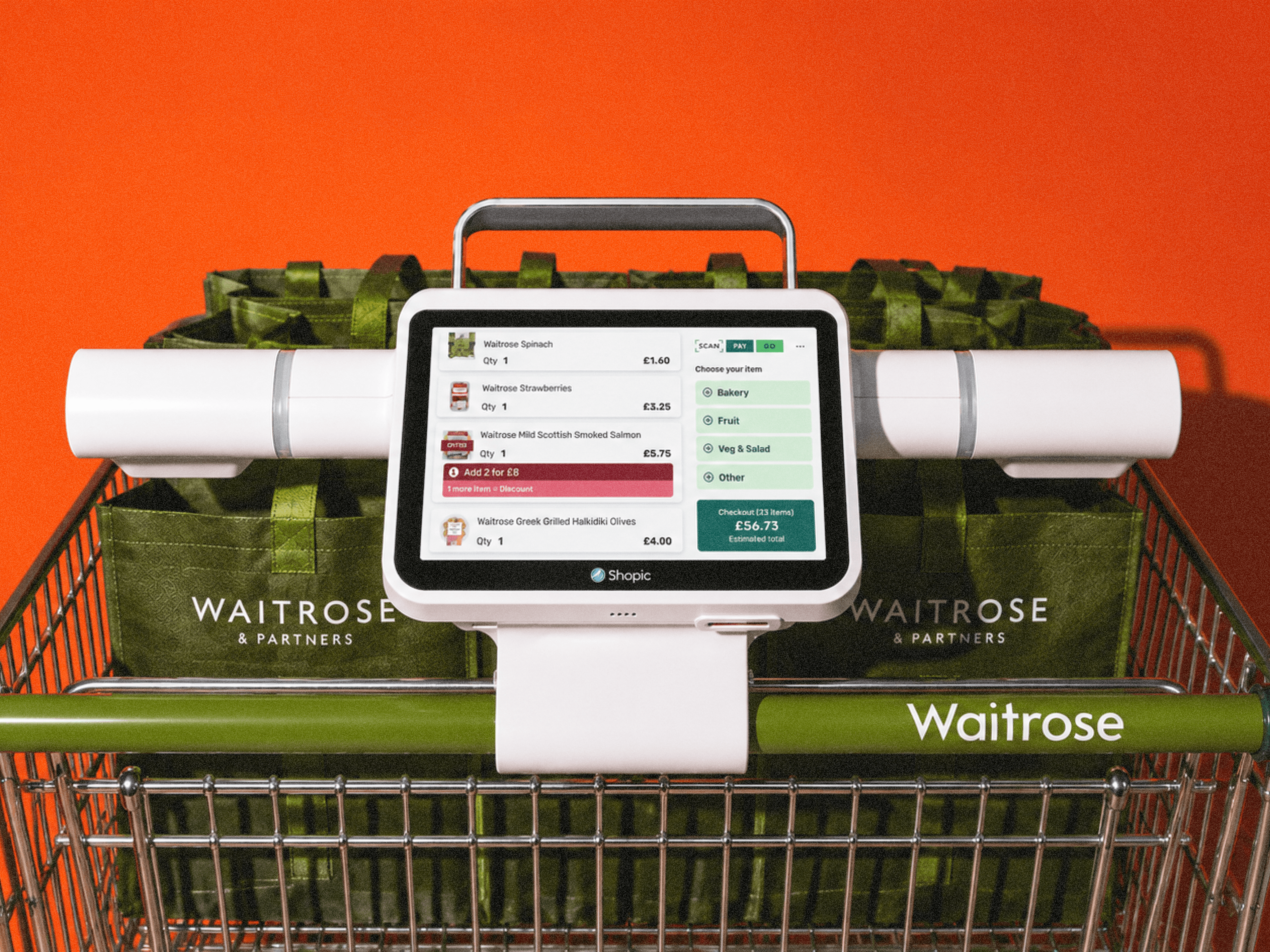
Shopic was a live Waitrose innovation trial exploring AI-assisted smart trolley technology designed to support more frictionless in-store shopping experiences. As part of one of the first smart trolley trials within a UK supermarket environment, my role focused on refining and adapting the customer-facing experience to better align with Waitrose Scan Pay Go behaviours, accessibility standards, and real retail environments.
Company
Waitrose & Partners
Timeline
2025 Pilot Trial
Role
Product Designer and main design contact for the Waitrose Shopic trial
Project overview
Waitrose trialled Shopic’s AI-powered smart trolley devices to explore how barcode scanning and computer vision technology could support faster, lower-friction shopping journeys within live store environments. As part of the trial, my role focused on refining and adapting the existing customer experience to better suit Waitrose customers, behaviours, and operational requirements.
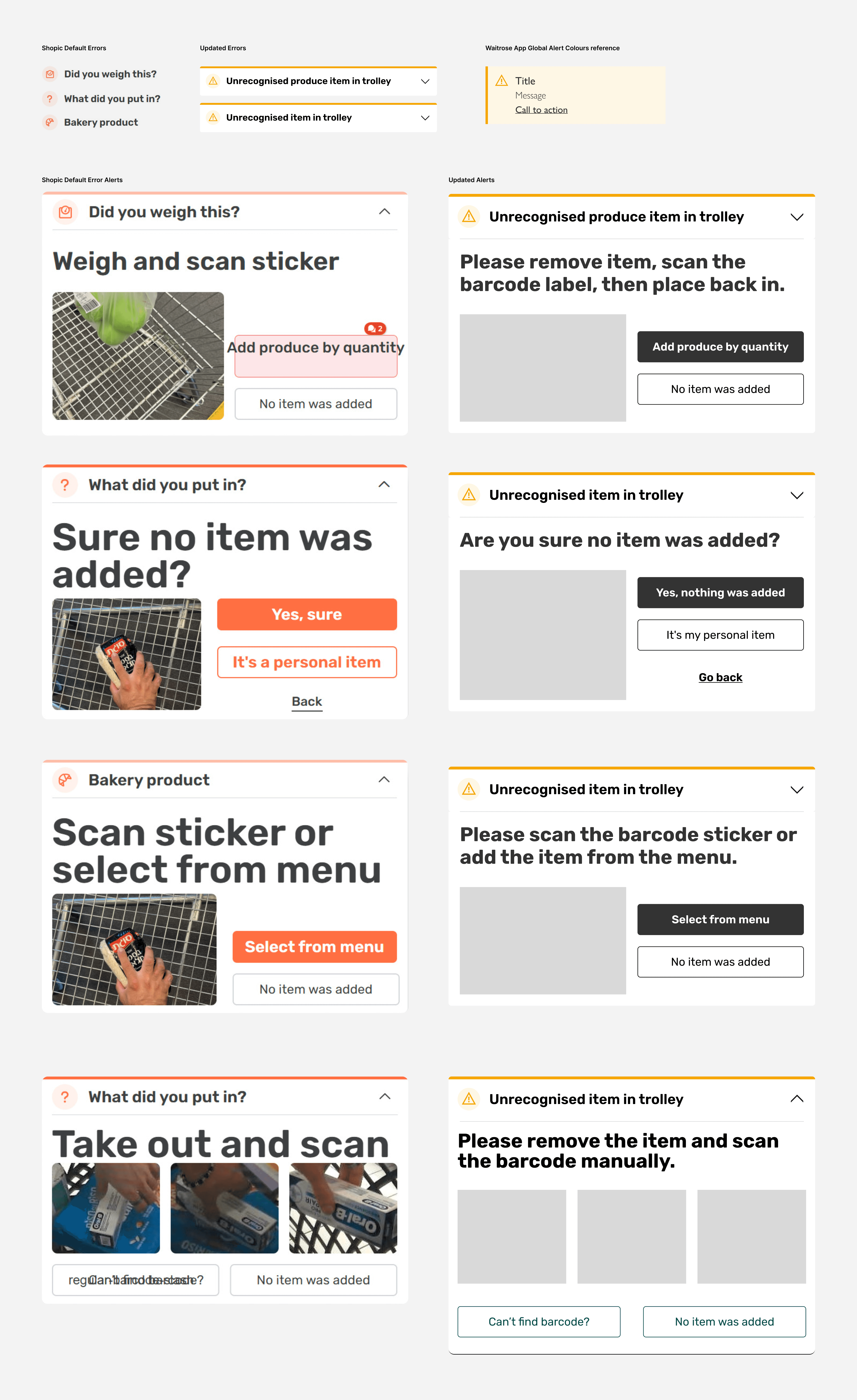
Working closely with Shopic, POS teams, researchers, and internal stakeholders, I refined the experience across onboarding, checkout flows, interaction feedback, UI hierarchy, and customer guidance. I also helped localise the platform by adapting generic non-UK terminology and system messaging into clearer interactions aligned with Waitrose tone of voice and Scan Pay Go conventions.
As testing progressed, the experience evolved rapidly through collaborative feedback sessions, helping shape usability-led decisions around scanning behaviour, rollout readiness, and customer interaction patterns.
Challenges
A key challenge was improving an existing third-party platform without rebuilding the experience entirely. The goal was to make the interface feel more intuitive, trustworthy, and aligned with Waitrose Scan Pay Go behaviours while working within the limitations of the existing system.
Research and in-store testing exposed friction around onboarding, payment terminology, item removal, and customer understanding of AI-assisted trolley behaviour. Because shoppers were interacting with the device while moving through busy store environments, clarity, readability, and customer confidence became critical across every screen.
The project also highlighted the challenges of introducing evolving computer vision technology into real retail environments, where scanning reliability and recognition accuracy directly impacted usability and trust.

The Bracknell trial extended beyond interface design, requiring close collaboration across UX, POS, operational, and Shopic teams to align device behaviour, checkout journeys, and customer interactions into a cohesive retail experience.

One of my key focuses throughout the project was improving how the experience communicated with customers. This included refining tone of voice, simplifying UX copy, improving instructional clarity, and aligning visual feedback patterns more closely with existing Waitrose design standards.
The original onboarding relied heavily on static illustrations and technical instructions, which felt difficult to follow in fast-moving retail environments. To make the experience feel more intuitive and accessible, I replaced many of the illustrations with short instructional videos demonstrating real device interactions and expected customer behaviours.


Results
The Shopic trial provided valuable insight into the realities of introducing AI-assisted retail technology into live supermarket environments, helping uncover both usability opportunities and technology limitations across customer interaction, scanning behaviour, and operational workflows.
My contribution focused on refining the overall customer experience through clearer screen layouts, improved typography hierarchy, simplified UX copy, and more intuitive interaction patterns informed by in-store testing and stakeholder feedback. These refinements helped create a more accessible and customer-friendly experience while better aligning the platform with existing Waitrose Scan Pay Go behaviours and retail standards. Feedback from both internal stakeholders and Shopic teams reinforced how much the refined UX and UI improved the overall rollout experience across the devices, POS integration, and customer-facing interactions.
As the pilot evolved, usability findings and operational feedback led to a simplified barcode-first approach, prioritising reliability and customer confidence over fully automated computer vision interactions. While the wider rollout was ultimately not progressed long term due to technology limitations, the project provided valuable learning around accessibility, behavioural design, operational constraints, and the integration of emerging retail technology into physical store environments.
Shopic was a live Waitrose innovation trial exploring AI-assisted smart trolley technology designed to support more frictionless in-store shopping experiences. As part of one of the first smart trolley trials within a UK supermarket environment, my role focused on refining and adapting the customer-facing experience to better align with Waitrose Scan Pay Go behaviours, accessibility standards, and real retail environments.
Company
Waitrose & Partners
Timeline
2025 Pilot Trial
Role
Product Designer and main design contact for the Waitrose Shopic trial
Project overview
Waitrose trialled Shopic’s AI-powered smart trolley devices to explore how barcode scanning and computer vision technology could support faster, lower-friction shopping journeys within live store environments. As part of the trial, my role focused on refining and adapting the existing customer experience to better suit Waitrose customers, behaviours, and operational requirements.
Working closely with Shopic, POS teams, researchers, and internal stakeholders, I refined the experience across onboarding, checkout flows, interaction feedback, UI hierarchy, and customer guidance. I also helped localise the platform by adapting generic non-UK terminology and system messaging into clearer interactions aligned with Waitrose tone of voice and Scan Pay Go conventions.
As testing progressed, the experience evolved rapidly through collaborative feedback sessions, helping shape usability-led decisions around scanning behaviour, rollout readiness, and customer interaction patterns.
Challenges
A key challenge was improving an existing third-party platform without rebuilding the experience entirely. The goal was to make the interface feel more intuitive, trustworthy, and aligned with Waitrose Scan Pay Go behaviours while working within the limitations of the existing system.
Research and in-store testing exposed friction around onboarding, payment terminology, item removal, and customer understanding of AI-assisted trolley behaviour. Because shoppers were interacting with the device while moving through busy store environments, clarity, readability, and customer confidence became critical across every screen.
The project also highlighted the challenges of introducing evolving computer vision technology into real retail environments, where scanning reliability and recognition accuracy directly impacted usability and trust.
The Bracknell trial extended beyond interface design, requiring close collaboration across UX, POS, operational, and Shopic teams to align device behaviour, checkout journeys, and customer interactions into a cohesive retail experience.
One of my key focuses throughout the project was improving how the experience communicated with customers. This included refining tone of voice, simplifying UX copy, improving instructional clarity, and aligning visual feedback patterns more closely with existing Waitrose design standards.
The original onboarding relied heavily on static illustrations and technical instructions, which felt difficult to follow in fast-moving retail environments. To make the experience feel more intuitive and accessible, I replaced many of the illustrations with short instructional videos demonstrating real device interactions and expected customer behaviours.
Results
The Shopic trial provided valuable insight into the realities of introducing AI-assisted retail technology into live supermarket environments, helping uncover both usability opportunities and technology limitations across customer interaction, scanning behaviour, and operational workflows.
My contribution focused on refining the overall customer experience through clearer screen layouts, improved typography hierarchy, simplified UX copy, and more intuitive interaction patterns informed by in-store testing and stakeholder feedback. These refinements helped create a more accessible and customer-friendly experience while better aligning the platform with existing Waitrose Scan Pay Go behaviours and retail standards. Feedback from both internal stakeholders and Shopic teams reinforced how much the refined UX and UI improved the overall rollout experience across the devices, POS integration, and customer-facing interactions.
As the pilot evolved, usability findings and operational feedback led to a simplified barcode-first approach, prioritising reliability and customer confidence over fully automated computer vision interactions. While the wider rollout was ultimately not progressed long term due to technology limitations, the project provided valuable learning around accessibility, behavioural design, operational constraints, and the integration of emerging retail technology into physical store environments.